

Frequently Asked Questions
Learn about types of abuse and assault, the relationship spectrum, trauma, and more.
Is this abuse? and more FAQs
Questions or concerns about your relationship? You can always ask us. Call our hotline to talk to an advocate: 703-237-0881.
Explore the FAQs below to learn about types of abuse and assault, the relationship spectrum, trauma, and more.
Domestic Violence
Domestic violence (also referred to as intimate partner violence (IPV), dating abuse, or relationship abuse) is a pattern of behaviors used by one partner to maintain power and control over another partner in an intimate relationship. Learn more from the National Domestic Violence Hotline.
Visit the National Domestic Violence Hotline to learn about common signs of abusive behavior. Even one or two of these behaviors in a relationship is a red flag that abuse may be present.
Multiple types of abuse usually occur in an abusive relationship, including sexual abuse and assault (intimate partner sexual violence). Understanding how abuse occurs and intersects can help you safely respond to situations. Learn more from the National Domestic Violence Hotline.
You can always ask us. Call Doorways’ 24-hour hotline at 703-237-0881 to discuss questions or concerns about your relationship, or a friend or love one’s situation.
According to love is respect, all relationships exist on a spectrum from healthy to abusive, with unhealthy relationships somewhere in the middle. Explore this interactive Relationship Spectrum by rating different scenarios as healthy, unhealthy, or abusive and find out where your own relationship falls. Learn more.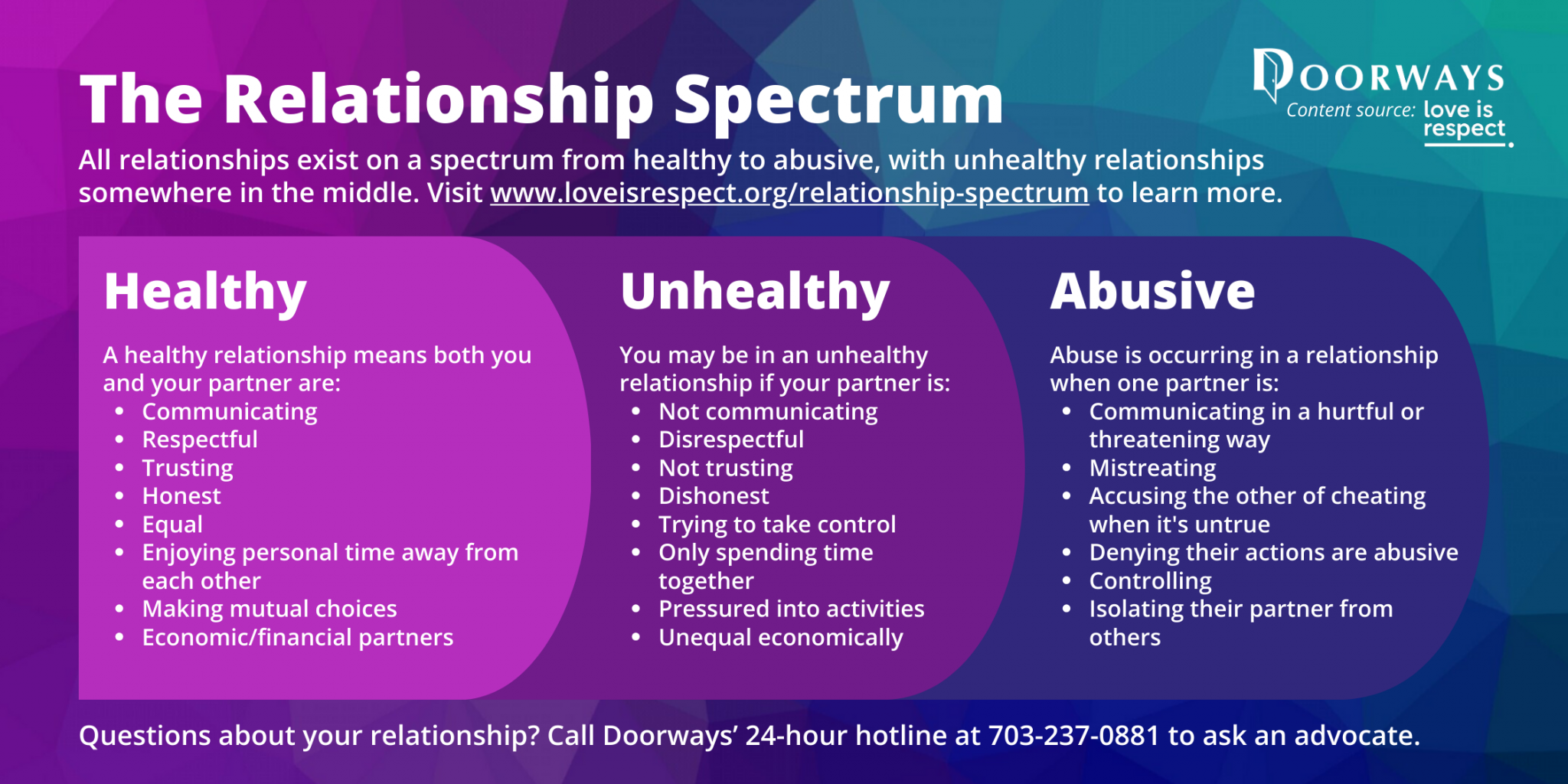
The Relationship Spectrum
Content source: Love is respect
Healthy: A healthy relationship means both you and your partner are communicating, respectful, trusting, honest, equal, enjoying personal time away from each other, making mutual choices, and are economic/financial partners.
Unhealthy: You may be in an unhealthy relationship if your partner is not communicating, disrespectful, not trusting, dishonest, trying to take control, if you and your partner are only spending time together, if you feel pressured into activities, or if you and your partner are unequal economically.
Abusive: Abuse is occurring in a relationship when one partner is communicating in a hurtful or threatening way, mistreating, accusing the other of cheating when it’s untrue, denying their actions are abusive, controlling, and/or isolating their partner from others.
You can always ask us. Call Doorways’ 24-hour hotline at 703-237-0881 to discuss questions or concerns about your relationship, or a friend or love one’s situation.
According to love is respect, all relationships exist on a spectrum from healthy to abusive, with unhealthy relationships somewhere in the middle. Explore this interactive Relationship Spectrum by rating different scenarios as healthy, unhealthy, or abusive and find out where your own relationship falls. Learn more.
The Relationship Spectrum
Content source: Love is respect
Healthy: A healthy relationship means both you and your partner are communicating, respectful, trusting, honest, equal, enjoying personal time away from each other, making mutual choices, and are economic/financial partners.
Unhealthy: You may be in an unhealthy relationship if your partner is not communicating, disrespectful, not trusting, dishonest, trying to take control, if you and your partner are only spending time together, if you feel pressured into activities, or if you and your partner are unequal economically.
Abusive: Abuse is occurring in a relationship when one partner is communicating in a hurtful or threatening way, mistreating, accusing the other of cheating when it’s untrue, denying their actions are abusive, controlling, and/or isolating their partner from others.

Call Our Hotline: 703-237-0881
For support, information, help with safety planning, and referrals to services, please contact Doorways’ 24-hour hotline at 703-237-0881. All languages available.
Sexual Violence
The term sexual violence is an all-encompassing, non-legal term that refers to crimes like sexual assault, rape, and sexual abuse. Learn more from RAINN.
The term sexual assault refers to sexual contact or behavior that occurs without explicit consent of the victim. Learn more from RAINN.
Some forms of sexual assault include:
• Attempted rape
• Fondling or unwanted sexual touching
• Forcing a victim to perform sexual acts, such as oral sex or penetrating the perpetrator’s body
• Penetration of the victim’s body, also known as rape
• Learn more from RAINN
Rape is a form of sexual assault, but not all sexual assault is rape. The term rape is often used as a legal definition to specifically include sexual penetration without consent. For its Uniform Crime Reports, the FBI defines rape as “penetration, no matter how slight, of the vagina or anus with any body part or object, or oral penetration by a sex organ of another person, without the consent of the victim.” Learn more from RAINN.
Force doesn’t always refer to physical pressure. Perpetrators may use emotional coercion, psychological force, or manipulation to coerce a victim into non-consensual sex. Learn more from RAINN.
It’s not always obvious when someone you care about has been affected by sexual violence. Learning the warning signs for children, teens, and college-age adults can help you know when to act. Visit RAINN to learn more.
Consent is an agreement between participants to engage in sexual activity. When you’re engaging in sexual activity, consent is about communication—and it should happen every time. Learn more from RAINN.
Consent = FRIES
Consent can seem complicated, but it doesn’t have to be. The FRIES acronym from Planned Parenthood helps keep it simple:
Freely given: Consenting is a choice you make without pressure, manipulation, or under the influence of drugs or alcohol.
Reversible: Anyone can change their mind about what they feel like doing, anytime. Even if you’ve done it before, and even if you’re both naked in bed.
Informed: You can only consent to something if you have the full story. For example, if someone says they’ll use a condom and then they don’t, there isn’t full consent.
Enthusiastic: When it comes to sex, you should only do stuff you WANT to do, not things that you feel you’re expected to do.
Specific: Saying yes to one thing (like going to the bedroom to make out) doesn’t mean you’ve said yes to others (like having sex).
Trauma
Trauma is the unique individual experience of an event or enduring condition in which the individual experiences a threat to life or to their psychic or bodily integrity, and experiences intense fear, helplessness, or horror. A key aspect of what makes something traumatic is that the individual’s coping capacity and/or ability to integrate their emotional experience is overwhelmed. Trauma often impacts individuals in multiple domains, including physical, social, emotional, and/or spiritual. Learn more from the National Resource Center on Domestic Violence.
After experiencing a traumatic incident, it is important to remember that there is no right way to cope with the event, and every individual deals with the trauma in their own way. It is normal to feel some, all, or none of the following reactions. If you experience any of these reactions, you have options. Support is available. Please call our 24/7 hotline at 703-237-0881 for information, support, and to access our programs.
Emotional Reactions
• Shame
• Guilt
• Self-blame
• Anger
• Anxiety
• Depression
• Mood swings
• Feeling numb
• Denial
• Loss of interest in things you used to enjoy
• Distancing yourself from friends/family
• Feeling out of control
• Trouble concentrating
• Crying or the inability to cry
• Nightmares and/or flashbacks to the incident
• Thoughts of suicide or self-harm (seek help immediately: Suicide & Crisis Lifeline 988)
Physical Reactions
• Increased heart rate
• Increased breathing rate
• Increased blood pressure
• Tensing of muscles
• Headaches
• Changes in sleep patterns (sleep too much/not enough/not at all)
• Being easily startled by an unexpected noise or touch
• Changes in eating habits (eating too much/no appetite)
• Loss of interest in sex or sexual activity
• Gastrointestinal disturbances (stomach aches, nausea)
Trauma-informed care shifts the focus from “what’s wrong with you” to “what happened to you?”; and then, to “what’s strong with you?” It is a universal relationship-based approach in which all providers recognize, respond to, and prevent the effects of traumatic stress. Learn more from National Center for Relational Health and Trauma-Informed Care.